Percentage of Total (Percentage Share): Formula and Examples
How to work out each part's percentage of a total, also called percentage share, and how to make the shares add up to 100%.

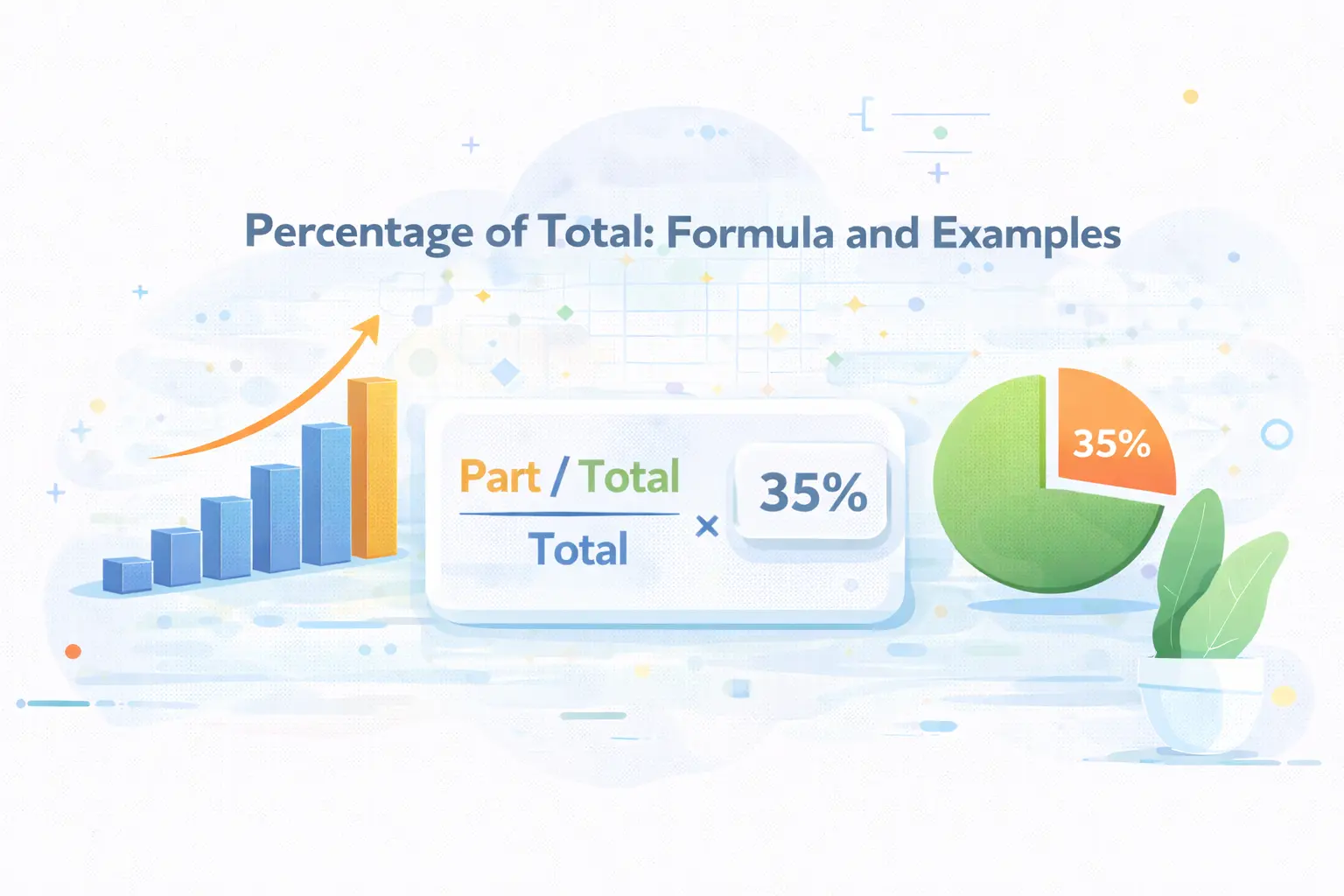
Percentage of total answers one question: out of the whole, how big is this slice? Revenue from one product against total revenue. Leads from one channel against all leads. Rent against your monthly budget. In business it's often called percentage share; the maths is the same. What trips people up is almost never the division. It's the total they divide by.
The formula
Percentage of total = part ÷ total × 100
Say one channel brought 45 of your 180 leads last month. 45 ÷ 180 = 0.25, so that channel is 25% of your leads. The steps never change: take the part, divide by the real total, multiply by 100.
Breaking a whole into parts
The typical use is splitting one total into several parts. Here is a monthly budget of 3,000:
| Category | Amount | Share of total |
|---|---|---|
| Rent | 1,200 | 1,200 ÷ 3,000 = 40% |
| Food | 600 | 600 ÷ 3,000 = 20% |
| Transport | 300 | 300 ÷ 3,000 = 10% |
| Everything else | 900 | 900 ÷ 3,000 = 30% |
| Total | 3,000 | 100% |
Every row divides by the same total, and the shares add up to 100%. If they don't, something is off; the next two sections cover what.
The total is the part that goes wrong
Nearly every wrong share I've had to fix came from the denominator, not the arithmetic.
- Dividing by the wrong total. For a product's share of revenue, the denominator is total revenue, not total units sold and not the biggest competitor's number. It sounds too obvious to matter. It's still the most common mistake.
- Overlapping categories. Shares only add to 100% when every part belongs to the same whole and nothing is counted twice. A customer who came through two channels can't be credited fully to both, or your shares quietly climb past 100%.
- Mixing time periods. This month's part over last month's total is a number that means nothing. Keep both sides in the same window.
When the shares refuse to add up to 100%
Round each share to a whole number and they'll often sum to 99% or 101%. Three equal thirds round to 33% + 33% + 33% = 99%. That's not a bug, it's rounding. The usual fix is to let the largest slice absorb the leftover (33% + 33% + 34%) so the total reads 100%. If a chart has to sum exactly, do that on purpose rather than hoping the numbers cooperate.
Market share
Market share is this exact formula with your sales as the part and the whole market as the total. If you sold 2.4 million in a market worth 16 million, your share is 2.4 ÷ 16 = 15%. The hard part is agreeing on what "the market" is; once the total is defined, the rest is one division.
Percentage of total in Excel or Google Sheets
Put the amounts in B2:B5 and the total in B6 (=SUM(B2:B5)). In C2, use:
=B2/$B$6
Format the column as a percentage and copy the formula down. The dollar signs lock the reference to the total, so every row divides by the same cell; without them, the copied formulas drift down the column and return errors. You can also skip the total cell with =B2/SUM($B$2:$B$5). More in our guide to percentages in Excel.
Share or change? Different questions
If you are asking what slice of the whole something is, that's share. If you are asking how much it grew from before, that's percentage change, a completely different formula. Same percent sign, different question. It's worth being sure which one the person asking actually wants before you hand them a figure, because the numbers can look plausible either way.
FAQ
Is percentage share the same as percentage of total?
Yes, the arithmetic is identical. "Share" is just the business-flavoured name, usually used when the parts compete with each other (products, channels, vendors) rather than being a neutral breakdown of a total.
Can the shares add up to more than 100%?
Not if every part belongs to one total and the categories don't overlap. If they add up to more, your categories probably overlap and need cleaning up; the formula isn't wrong.
Can a single share be more than 100%?
Not as a share of a total it belongs to. If one part comes out above 100%, it isn't really part of that total, or the total is wrong. Comparing two separate numbers, like 18 deals against a target of 12, can give 150%, but that's a different question: see what percent one number is of another.
Check your numbers
For a single part, the "X is what percent of Y?" mode of the percentage calculator on our home page gives the share and shows the working.